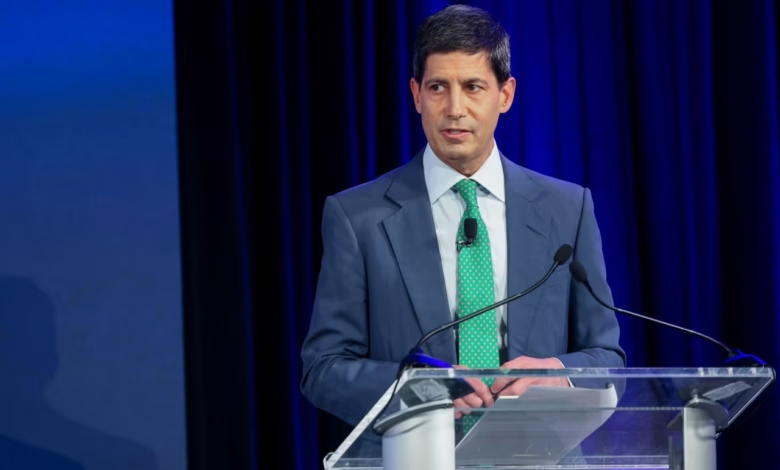
In the high-stakes, often dry world of central banking, few names spark as much conversation—and occasionally as much controversy—as Kevin Warsh. If you’ve been following the financial headlines lately, especially with the seismic shifts in the 2026 economic landscape, you know that Warsh is much more than just a former Fed Governor. He is a rare breed in Washington and Wall Street: a policy wonk who speaks the language of the markets fluently, and a veteran of the “Great Recession” trenches who has managed to stay relevant through multiple administrations.
The story of Kevin Warsh is essentially a masterclass in the intersection of finance, politics, and power. At an age when most people are still trying to figure out their mid-career goals, Warsh was already helping steer the global economy through its most significant crisis since the 1930s. Today, as he stands as the freshly announced nominee to succeed Jerome Powell as Chair of the Federal Reserve, the eyes of the world are on his every speech and op-ed. Understanding kevin warsh isn’t just an academic exercise; it’s a prerequisite for anyone trying to guess where interest rates, inflation, and the U.S. dollar are headed next.
What makes Warsh an “expert’s expert” is his ability to bridge the gap between abstract economic theory and the gritty reality of trading floors. He doesn’t just look at a spreadsheet; he looks at how the plumbing of the financial system reacts to every turn of the screw. In this deep dive, we’re going to look at the man behind the headlines, his controversial views on “monetary groupthink,” and what his potential leadership at the Fed means for the future of your wallet.
The Youngest Governor: A Trial by Fire in 2008
To understand Kevin Warsh, you have to go back to 2006. When President George W. Bush nominated him to the Federal Reserve Board of Governors, the reaction in some circles was essentially, “Wait, he’s how old?” At 35 years old, Warsh became the youngest person ever appointed to the Board. Critics at the time pointed to his age and his background as a Mergers and Acquisitions specialist at Morgan Stanley as evidence that he lacked the “academic rigor” traditionally required for the job. They were looking for a PhD economist; what they got was a pragmatic financier with a law degree from Harvard.
However, that Wall Street pedigree proved to be exactly what the Fed needed when the housing bubble burst. As the 2008 financial crisis began to unravel the global economy, Warsh became Ben Bernanke’s primary liaison to the financial world. While the academic types were busy debating models, Warsh was the guy on the phone with bank CEOs, trying to figure out which institutions were solvent and which were about to sink the ship. He was a central figure in the “rescue” operations, including the navigations of the Group of Twenty (G-20) and the complex negotiations that kept the credit markets from freezing entirely.
Looking back, his tenure was a masterclass in crisis management. He didn’t just sit in the boardroom; he acted as an “emissary” to emerging markets and established economies alike. This period defined his philosophy: that the Fed should be a powerful force in times of extreme distress, but otherwise, it should stay out of the way. It was during these years that he began to develop the skepticism of “endless stimulus” that would later define his public profile.
Challenging the “Guild”: Warsh as the Monetary Dissenter

After leaving the Federal Reserve in 2011, Kevin Warsh didn’t fade into a quiet retirement in academia. Instead, he became one of the most vocal critics of the very institution he once helped lead. At the Hoover Institution at Stanford, he began writing and speaking about what he calls the “groupthink” of the central banking community. In his view, the Fed has become too insulated, relying on a narrow set of economic models that don’t always reflect how the real world—or the markets—actually work.
His departure from the Fed was itself a statement. He resigned in 2011, largely because he was uncomfortable with the scale of Quantitative Easing (QE)—the practice of printing money to buy government bonds. Warsh famously referred to QE as a “reverse Robin Hood” policy, arguing that while it pushed up the prices of assets like stocks (benefiting the wealthy), it did little to help the average worker on “Main Street.” This hawkish stance made him a hero to fiscal conservatives but a thorn in the side of those who believed the Fed should do “whatever it takes” to boost growth.
In 2026, his critique has only sharpened. Warsh has been a frequent contributor to the Wall Street Journal, arguing that the Fed’s recent struggles with inflation were a direct result of being too slow to react and too married to their own forecasts. He advocates for what he calls a “regime change” in policy—moving away from minute-by-minute data dependence and toward a more stable, long-term framework. When he talks about “Challenging the Groupthink of the Guild,” he’s essentially calling for a return to a more humble, less intrusive central bank.
The 2026 Nomination: A New Era for the Federal Reserve?
The recent announcement by President Trump nominating Kevin Warsh to succeed Jerome Powell is perhaps the most significant economic pivot of the decade. As of late January 2026, the markets are already pricing in the “Warsh Effect.” But here is the paradox: Trump has been vocally demanding lower interest rates, while Warsh has spent much of the last decade being a “hawk” (someone who favors higher rates to prevent inflation). This has led to intense speculation about what a “Warsh Fed” would actually look like.
Experts suggest that Warsh may have found common ground with the current administration through his focus on productivity and innovation. He has often argued that if you fix the “micro” foundations of the economy—deregulation, better tax structures, and more investment—you can have higher growth without triggering inflation. This would allow the Fed to keep rates lower than a traditional economist might suggest. It’s a gamble, but it’s one that aligns with the “pro-growth” agenda currently dominating Washington.
If confirmed by the Senate, Warsh is expected to bring a “seismic” change to how the Fed communicates. He has suggested doing away with the “Summary of Economic Projections” (the infamous “dot plot”), which he views as a source of market confusion rather than clarity. He wants the Fed to be less of a “front-page news” item and more of a quiet, steady hand in the background. For the average consumer, this could mean more predictable borrowing costs, but also a central bank that is much less likely to come to the rescue the next time the stock market has a bad week.
Preparing for the “Warsh Transition”: What It Means for Your Money
As we look toward the transition in May 2026, the global financial landscape is bracing for impact. A Kevin Warsh-led Fed is likely to be a “dollar-friendly” Fed. Historically, his preference for a smaller Fed balance sheet and a focus on price stability has made the U.S. dollar more attractive to international investors. If you’re an investor, this means you might see a shift away from the speculative “easy money” stocks that thrived during the QE era toward companies with strong cash flows and real-world utility.
For those of us on “Main Street,” the Warsh era will likely be defined by a “tough love” approach to inflation. While he might support lower rates to help boost productivity, he is unlikely to tolerate the kind of persistent price increases we’ve seen in recent years. He has long warned about the “Financial Repression Trap,” where low interest rates effectively punish savers to help the government pay off its debt. Expect a Warsh Fed to prioritize the purchasing power of your dollar over the short-term fluctuations of the S&P 500.
Ultimately, Kevin Warsh represents a return to a more traditional, market-oriented view of central banking. He is a man who believes that the economy’s strength comes from the ingenuity of its people, not the printing presses of the central bank. Whether he can navigate the political pressures of 2026 while maintaining the Fed’s independence will be the ultimate test of his career. One thing is certain: with Warsh at the helm, the Federal Reserve will be anything but boring.