Rosa Parks is one of those rare historical figures whose words feel as alive as her actions. Most people know her as the woman who refused to give up her seat on a segregated bus in Montgomery, Alabama. But while that act of resistance sparked a movement, the things she said about courage, justice, and dignity left an equally lasting legacy. Rosa Parks quotes continue to show up in classrooms, leadership seminars, social movements, and personal journals—and they always seem to land with the same quiet force that defined her spirit.
In this article, we’ll take a deep dive into the meaning, impact, and enduring relevance of Rosa Parks’s most famous quotes. Instead of just listing them, we’ll explore why they mattered then and why they still matter now. Think of this as a guided conversation with Rosa Parks’s philosophy—delivered casually, but with the clarity and depth it deserves.
The Power of Courage in Simple Words
Rosa Parks never set out to be a celebrity or a symbol. In her own reflection, she emphasized that she was simply tired of giving in. One of her most recognized lines captures this feeling with beautiful simplicity:
“You must never be fearful about what you are doing when it is right.”
This quote may be short, but it hits like a hammer. Courage is rarely loud or flashy; often, it’s a quiet decision made in a moment that doesn’t feel dramatic at all. Parks’s words remind us that doing the right thing isn’t about fearlessness—it’s about acting despite fear. The brilliance of this quote lies in how ordinary it feels. It doesn’t promise glory or reward. It simply insists that the right thing is worth the risk.
What makes this quote even more powerful is how directly it applies to everyday life. You don’t have to be standing at the center of a civil rights movement to understand what Parks meant. Maybe you’re defending someone at school. Maybe you’re challenging an unfair policy at work. Maybe you’re confronting a personal limitation you’ve been avoiding for too long. Her words aren’t meant only for history—they’re meant for daily use.
And that’s why this quote has aged so well. It’s effortlessly universal. Anyone, from a teenager facing peer pressure to an adult facing systemic injustice, can draw strength from it. Rosa Parks distilled an entire philosophy of moral courage into one crisp, timeless sentence.
Dignity, Self-Worth, and the Refusal to Shrink
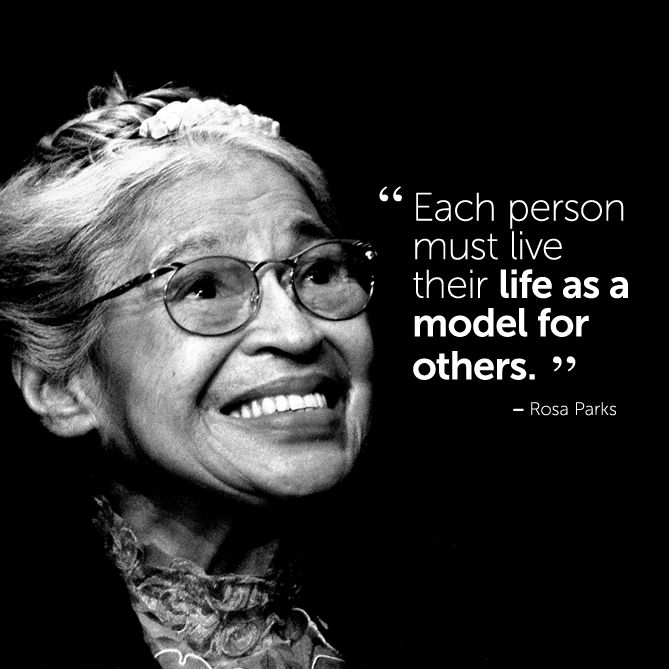
Rosa Parks Quotes ,Rosa Parks often spoke not only about freedom and justice but also about the importance of recognizing one’s own worth. One frequently shared sentiment from her emphasizes that she was not seeking confrontation; she simply believed she deserved to be treated as well as anyone else. Paraphrasing her perspective, Parks explained that no one should ever accept being treated as inferior or unworthy.
This idea may sound obvious today, but it was radical in an era when entire systems were built on telling Black Americans that they were “less than.” Her refusal to stand up wasn’t rebellion for rebellion’s sake—it was self-respect in action. She wanted people to understand that dignity is not granted by society; it is inherent. The world either honors it or violates it, but it cannot erase it.
What makes her reflections on dignity so compelling is the tenderness behind them. Parks didn’t frame her stance as combat. She wasn’t trying to be defiant; she was trying to be whole. In her own telling, she wasn’t physically tired that day—she was tired of giving in. That exhaustion wasn’t weakness. It was clarity.
When we read her words now, they feel just as relevant. In an age of online bullying, workplace exploitation, and daily pressures to conform, her insistence on self-worth is a needed reminder. Her message is simple: Don’t shrink to make others comfortable. If something violates your dignity, you have every right—maybe even an obligation—to resist it.
Freedom as a Collective Responsibility
Rosa Parks also spoke thoughtfully about freedom—not just her own freedom, but everyone’s. She reminded people that one person’s liberation is tied to the liberation of all. While some of her statements on this topic are longer and more biographical, the core idea remains consistent: no one is free until everyone is free.
This philosophy runs through many of her public reflections. She stressed that the civil rights movement wasn’t about one heroic moment but about thousands of people, big and small, fighting the same fight. She emphasized that progress requires cooperation, empathy, and collective action.
What’s striking is how modern her outlook feels. Today, social movements—from gender equality to disability rights to economic justice—echo the same message. Parks was ahead of her time in understanding that oppression doesn’t operate in isolated pockets. It’s connected. Therefore, freedom must also be connected.
By revisiting her words, we see that Rosa Parks did not view herself as a lone spark; she saw herself as part of a much larger fire. She understood that individual courage matters, but community courage transforms history. Her quotes about freedom are reminders that passivity keeps injustice alive. If something is wrong in the world, someone has to refuse to move. Someone has to speak up. Someone has to say “no more.”
And often, all it takes is one person to inspire another—and another—until it becomes a movement.
Legacy and Inspiration: Why Her Words Still Matter
Rosa Parks’s quotes endure because they are both simple and profound. She didn’t use complicated language or political jargon. She used the language of a person speaking from truth, heart, and experience. That’s why you’ll find her words printed on posters, recited during protests, and shared across social media daily.
But their impact is deeper than aesthetics. Her quotes teach lessons that are increasingly rare in a fast-paced world: the value of patience, the strength of quiet conviction, and the power of standing firm without becoming bitter. Parks insisted that change didn’t require aggression—it required integrity.
Her words also offer a model of leadership that contrasts sharply with the loud, performative activism often seen today. Rosa Parks’s activism was steady, consistent, and deeply moral. She didn’t need a spotlight to do the right thing; she simply refused to betray her conscience. Her quotes invite us to adopt the same humility and bravery.
Most importantly, her words continue to guide people who feel small or unheard. Rosa Parks proved that you don’t need power, status, or influence to make history. You just need a clear sense of right and wrong—and the courage to act on it.
Conclusion: Carrying Rosa Parks’s Wisdom Forward
Rosa Parks quotes remain among the most soul-stirring words in American history because they were never meant to be slogans; they were reflections of a lived reality. She spoke from the quiet strength of someone who believed deeply in human dignity and justice. Her refusal to surrender her bus seat is often celebrated, but it’s her words that carry that moment forward into the present.
Today, whether we face personal struggles or societal battles, Rosa Parks’s wisdom still offers a compass. Her courage reminds us to act when something is wrong. Her dignity teaches us to value ourselves even when others don’t. And her belief in collective freedom shows us that we are responsible not just for our own liberation, but for one another’s.
In a world that sometimes feels overwhelming, Rosa Parks’s quotes feel like anchors—steady, grounding, and forever relevant. And perhaps the greatest tribute we can offer is not just to repeat her words, but to live by them.