Roxie Hart Chicago: The Dazzling, Dangerous, and Unforgettable Icon of Jazz-Age Theatrics

Who Is Roxie Hart? Understanding the Icon at the Center of Chicago
Roxie Hart isn’t just a character; she’s an attitude, a warning, and a spark of glittering ambition wrapped in a 1920s fringe dress. At her core, Roxie is an ordinary woman with extraordinary dreams—dreams that push her into the spotlight for all the wrong reasons and keep her there through sheer charm, cunning, and theatrical instinct. It’s that combination of innocence and manipulation that makes her one of musical theatre’s most fascinating protagonists.
In the world of Chicago, Roxie starts as a chorus-girl-wannabe whose life feels painfully small. Her days are spent in a cramped apartment with her loyal but dull husband, Amos. Yet, there’s always a fire burning under her politely smiling exterior: she wants fame, attention, and validation in a world that constantly overlooks her. That hunger becomes the trigger for everything that follows.
What sets Roxie apart from typical fictional characters is her paradoxical nature. She is self-absorbed but charming, naïve yet calculating, playful but deadly serious when it comes to her own success. That contradiction keeps audiences invested, entertained, and occasionally shocked. Through Roxie, Chicago isn’t merely telling a story about a crime—it’s exposing the relentless, seductive machinery of fame.
The Story Behind Roxie Hart: Crime, Media, and the Allure of Celebrity

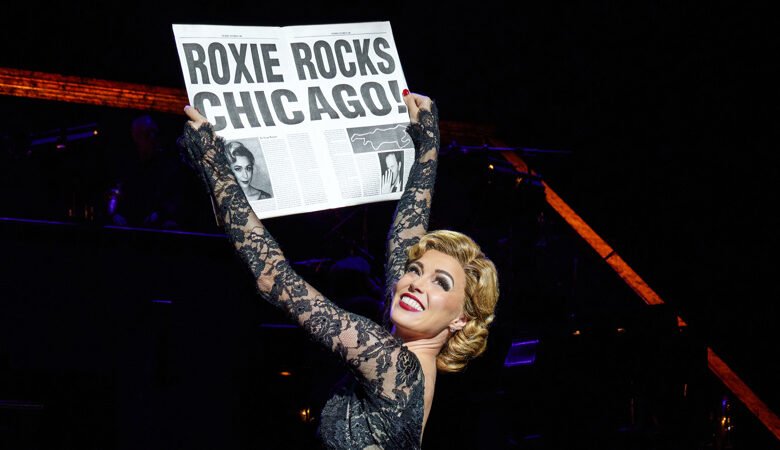
Roxie Hart Chicago ,Roxie Hart’s story begins with a bang—literally. After discovering that her lover Fred Casely lied to her and planned to leave her, she shoots him in a moment of impulsive rage. Instead of panicking, Roxie turns the situation into an opportunity, one that propels her into the chaotic world of headlines, newspaper feuds, and courtroom theatrics. Her sudden fame becomes the spotlight she always believed she deserved.
Because Chicago is based on real 1920s events, Roxie’s story is laced with social commentary. Women accused of murder during that era often received enormous media attention, and savvy defendants used that publicity to shape public opinion. Roxie Hart embodies that phenomenon perfectly—she quickly learns how to charm reporters, manipulate narratives, and reinvent herself as a misunderstood, glamorous heroine. Her crime becomes her ticket to celebrity.
The brilliance of Roxie’s character lies in her ability to play both victim and star. She recognizes how easily the media can be seduced, and she leans into that power with skill. Instead of letting the system swallow her, she feeds it a dazzling performance, transforming her trial into a stage show. In many ways, Roxie doesn’t just navigate fame—she manufactures it, proving that in a culture obsessed with spectacle, truth becomes optional.
Roxie Hart’s Relationship With Velma Kelly: Rivalry, Reflection, and the Pursuit of Stardom
One of the most compelling dynamics in Chicago is the rivalry between Roxie Hart and Velma Kelly. While Velma is already a household name on the vaudeville circuit, Roxie becomes the rising star determined to outshine her. Their tension isn’t just entertaining—it mirrors the competitive nature of fame itself, where one headline can make or break a career.
At first, Velma views Roxie as nothing more than an annoying amateur invading her territory. Roxie, meanwhile, sees Velma as the image she wants to project: glamorous, confident, adored. The jealousy flows both ways as Roxie’s case begins to overshadow Velma’s, and reporters shift their attention to the new murderess in town. Their rivalry is comedic, sharp, and often painfully relatable in its exploration of how women navigate competitive spaces that pit them against one another.
But as the story evolves, something unexpected happens. Both women realize that the true villain in their world isn’t each other—it’s the fickle, exploitative nature of media culture. When the spotlight moves on, it abandons everyone eventually. Their final collaboration symbolizes not friendship exactly, but a shared understanding: in a world built on spectacle, survival requires strategy, adaptability, and sometimes unlikely alliances. Together, Roxie and Velma become a powerhouse duo, proving that even in a cutthroat industry, partnership can be just as valuable as rivalry.
Fame, Fantasy, and Fear: The Psychology Behind Roxie Hart
Beneath the glitz and humor, Roxie Hart’s psychology is surprisingly layered. She’s not simply a manipulative showgirl or a misunderstood woman—she’s a mirror reflecting the human desire to be seen, applauded, and remembered. Everything she does stems from a desperate longing for validation, shaped by a world that measures women by their charm and marketability long before their worth.
What makes Roxie so compelling is her uncanny blend of vulnerability and self-illusion. She genuinely believes she is born to be a star, even when her talents are questionable and her ambitions border on delusion. Yet that belief is precisely what fuels her transformation. Roxie doesn’t merely pretend her life is a stage—she internalizes it as truth. Her fantasies, often depicted in the musical through bold theatrical sequences, reveal her craving for control in a world where she often feels powerless.
Still, there’s an underlying loneliness in Roxie that the audience can’t ignore. When the applause fades and the headlines move on, she confronts the uncomfortable reality that fame is temporary. Her chase for stardom highlights a broader cultural message: the pursuit of celebrity can be intoxicating but emotionally hollow. Roxie Hart becomes a reminder that when your identity depends on outside approval, the spotlight can both elevate and destroy.
Why Roxie Hart Endures: A Legacy That Outshines the Jazz Age
Decades after Chicago first premiered, Roxie Hart remains one of the most recognizable figures in stage and film history. Part of her enduring appeal is her fearless theatricality—she’s bold, dramatic, and unapologetically flawed. She broke the mold of traditional female characters by embracing ambition, self-preservation, and moral ambiguity. Roxie isn’t the heroine we’re supposed to admire; she’s the heroine we can’t help watching.
The real power of Roxie’s legacy lies in how modern audiences interpret her story. In an age dominated by social media fame, viral scandals, and influencer culture, Roxie Hart feels more relevant than ever. Her journey exposes the mechanics behind public image, the theatre of trials in the court of public opinion, and the way scandals are monetized. She predicted an entire era before it happened.
Even beyond cultural commentary, Roxie endures because she’s entertaining. She’s dazzlingly witty, frustratingly self-centered, and endlessly compelling. Every performer who portrays her brings something fresh—a wink, a flourish, a new shade of vulnerability. Roxie Hart isn’t just a character; she’s a performance, a persona, a legacy that continues to evolve with each retelling. And that makes her one of the most unforgettable figures in musical theatre.